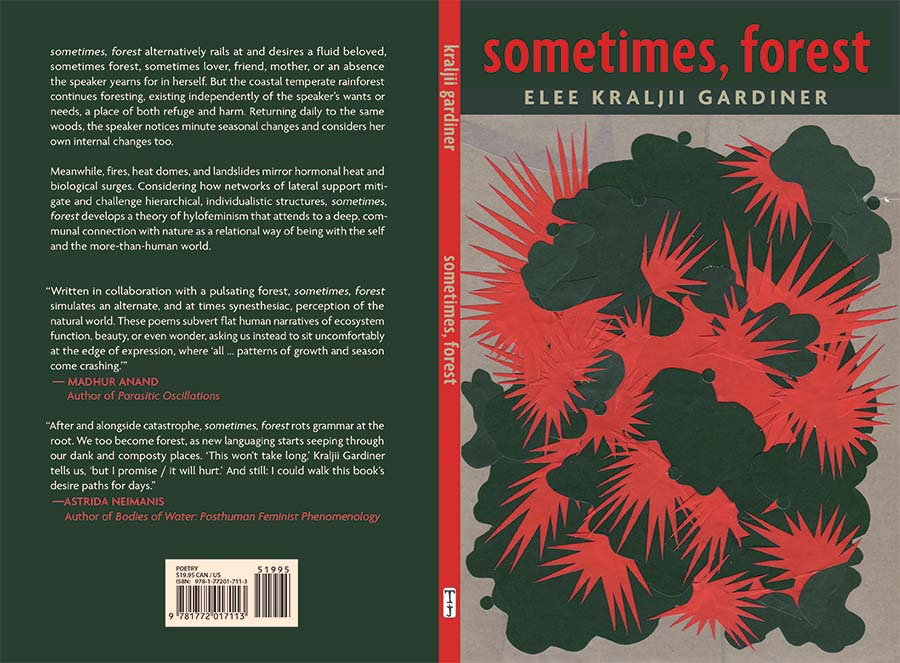
A new collection by Elee Kraljii Gardiner, sometimes, forest alternatively rails at and desires a fluid beloved, sometimes forest, sometimes lover, friend, mother, or an absence the speaker yearns for in herself. But the coastal temperate rainforest continues foresting, existing independently of the speaker’s wants or needs, a place of both refuge and harm. Returning daily to the same woods, the speaker notices minute seasonal changes and considers her own internal changes too.
“Elee Kraljii Gardiner’s extraordinary latest collection is a lush, layered, textured invitation into an interconnected web of beings centred on, but not exclusive to, the forest — not a setting or a medium in these poems, but a “co-creator and narrator” with its own interests”
“My first reading of sometimes, forest by Vancouver poet Elee Kraljii Gardiner, established a primal, earthy layer composed of mulchy fragments, forgotten roots, mycorrhizal detritus within me…[and] engages with the land as language, the lacunas, punctuation play, twists of diction, weavings in of prior and partial poetic lines”
“ramps up an approach to language in its pure form, and the poems of sometimes, forest have such a wonderful thick and rich quality, a mélange of sound and bounce and visual play, offering a layered density of language as thick and teeming with life as any forest floor.”
Written in collaboration with a pulsating forest, sometimes, forest, simulates an alternate, and at times synesthesiac, perception of the natural world. These poems subvert flat human narratives of ecosystem function, beauty, or even wonder, asking us instead to sit uncomfortably at the edge of expression, where ‘all … patterns of growth and season come crashing.
— MADHUR ANAND
Author of Parasitic Oscillations
After and alongside catastrophe, sometimes, forest rots grammar at the root. We too become forest, as new languaging starts seeping through our dank and composty places. ‘This won’t take long,’ Kraljii Gardiner tells us, ‘but I promise / it will hurt.’ And still: I could walk this book’s desire paths for days.
— ASTRIDA NEIMANIS
Author of Bodies of Water: Posthuman Feminist Phenomenology